Sign Up To The Free Email Newsletter!

Want to get notified whenever we produce the latest content ? Then subscribe now to start receiving hot updates from today.

Showing posts with label Mechanical Engineering. Show all posts

9 January 2014

Lathe Machine Operations New techniques

Working Principle: The lathe is a machine tool which holds the workpiece between two rigid and strong supports called centers or in a chuck or face plate which revolves. The cutting tool is rigidly held and supported in a tool post which is fed against the revolving work. The normal cutting operations are performed with the cutting tool fed either parallel or at right angles to the axis of the work.
The cutting tool may also be fed at an angle relative to the axis of work for machining tapers and angles.
clip_image002
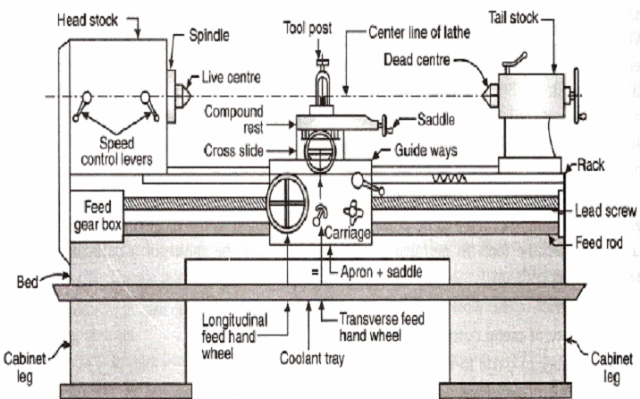
Construction: The main parts of the lathe are the bed, headstock, quick changing gear box, carriage and tailstock.
clip_image004
1. Bed: The bed is a heavy, rugged casting in which are mounted the working parts of the lathe. It carries the headstock and tail stock for supporting the workpiece and provides a base for the movement of carriage assembly which carries the tool.
2. Legs: The legs carry the entire load of machine and are firmly secured to floor by foundation bolts.
3. Headstock: The headstock is clamped on the left hand side of the bed and it serves as housing for the driving pulleys, back gears, headstock spindle, live centre and the feed reverse gear. The headstock spindle is a hollow cylindrical shaft that provides a drive from the motor to work holding devices.
4. Gear Box: The quick-change gear-box is placed below the headstock and contains a number of different sized gears.
5. Carriage: The carriage is located between the headstock and tailstock and serves the purpose of supporting, guiding and feeding the tool against the job during operation. The main parts of carriage are:
a). The saddle is an H-shaped casting mounted on the top of lathe ways. It provides support to cross-slide, compound rest and tool post.
b). The cross slide is mounted on the top of saddle, and it provides a mounted or automatic cross movement for the cutting tool.
c). The compound rest is fitted on the top of cross slide and is used to support the tool post and the cutting tool.
d). The tool post is mounted on the compound rest, and it rigidly clamps the cutting tool or tool holder at the proper height relative to the work centre line.
e). The apron is fastened to the saddle and it houses the gears, clutches and levers required to move the carriage or cross slide. The engagement of split nut lever and the automatic feed lever at the same time is prevented she carriage along the lathe bed.
6. Tailstock: The tailstock is a movable casting located opposite the headstock on the ways of the bed. The tailstock can slide along the bed to accommodate different lengths of workpiece between the centers. A tailstock clamp is provided to lock the tailstock at any desired position. The tailstock spindle has an internal taper to hold the dead centre and the tapered shank tools such as reamers and drills.
The engine lathe is an accurate and versatile machine on which many operations can be performed. These operations are:

1. Plain Turning and Step Turning
2. Facing
3. Parting
4. Drilling
5. Reaming
6. Boring
7. Knurling
8. Grooving
9. Threading
10. Forming

3 January 2014

Astm-Handbook Of Comparative Weld Steel Standards


Preface
This is the book I never wanted to write, but always wanted to own. As a metallurgical engineer and long time user of steel standards, author of the four CASTI Metals Data Books, and member of ASTM A01 and B02 standard committees, I knew all too well the many pitfalls and challenges of writing such a handbook. There were many steel standards from around the world that were new to me, which created far too many surprises and delays in completing this book.
Comparing steel standards is not an exact science, so the biggest challenge of preparing such a book was deciding on the "rules of comparison." Of the similar books on the market today, none explain in detail why one steel is comparable to another. They simply appear together in a list of steels. I kept a daily diary to help construct a workable set of comparison rules that I could share with other users to assist them in understanding how and why one steel is comparable to another.

Piping System & PipeLine


Content
Chapter 1. Piping History
Ancient Piping
U.S. and ASME Code Development

Chapter 2. Historical Development
Basis of Each Code
B31.1 power piping
B31.3 process piping
B31.4 pipeline transportation systems for liquid hydrocarbons and other liquids
B31.5 refrigeration piping and heat transfer components
B31.8 gas transmission and distribution piping systems
B31.9 building services piping
B31.11 slurry transportation piping systems
Code Organization
Definition of piping system

Process Plant Piping Maintenance & Repair


I. Introduction
The structural integrity of piping systems must be maintained after they have been placed into service so that they will provide safe, reliable, long-term operation. Therefore, existing piping systems require periodic inspection to determine their current condition and permit evaluation of their structural integrity to permit future operation. Should unacceptable deterioration or flaws be identified, pipe repairs may be required. Existing piping systems might also require alterations or rerating to accommodate new operational needs (or to
accommodate deterioration that cannot or will not be repaired).

Process plants must adopt and follow established procedures for the inspection, repair, alteration, and rerating of piping systems after they have been placed into service. API 570, “Piping Inspection Code – Inspection, Repair, Alteration, and Rerating of In-Service Piping Systems,” provides the basic procedures to be followed by process plants. This course is based on API 570.

Scope of API 570
API 570 was developed for the petroleum refining and chemical process industries. But since most of its requirements have broad applicability, it may be used for any piping system. It must be used by organizations that maintain or have access to an authorized inspection agency, a repair organization, and technically qualified piping engineers, inspectors, and examiners (as defined in API 570).

OVERVIEW OF PRESSURE VESSEL DESIGN


TABLE OF CONTENTS
Abstract5
Introduction6
Organizing Unit Responsibilities7
Instructor Guidelines and Responsibilities9
Overview of Pressure Vessel Design Outline Teaching Plan 11
Instructor Notes13
Appendix A: Reproducible Overheads
Appendix B: Course and Instructor Evaluation Form
Appendix C: Continuing Education Unit (CEU) Submittal Form
Course Improvement Form
Instructor’s Biography Form

1 MB 137 pages
Download
OR
http://www.4shared.com/office/qgUqn60r/OVERVIEW_OF_PRESSURE_VESSEL_DE.html

30 December 2013

Engineering Thermodynamics


Author : Tarik Al-Shemmeri

Publisher : bookboon, 01 January 2010

ISBN-13 : 978-87-7681-670-4

Number of pages : 107

Description :
Thermodynamics is an essential subject taught to all science and engineering students. If the coverage of this subject is restricted to theoretical analysis, students will resort to memorising the facts in order to pass the examination. Therefore, this book is set out with the aim to present this subject from an angle of demonstration of how these laws are used in practical situation. This book is designed for the virtual reader in mind, it is concise and easy to read, yet it presents all the basic laws of thermodynamics in a simplistic and straightforward manner; plus many worked examples and a good section of unsolved tutorial problems.

( 2.42MB, PDF ) 

Drilling Fluid Engineering


Author : Pål Skalle

Publisher : bookboon, 15 December 2011

ISBN-13 : 978-87-7681-929-3

Number of pages : 132

Description :
This book presents how to apply fluid mechanics on drilling fluid related challenges and explains the related physics involved and the different engineering approaches. Mud has many functions, the single most important one is to remove the cuttings a) away from under the bit and b) transport them from the bottom to the surface. Viscosity of drilling fluids is not a constant parameter; it varies with shear rate. Pipe, rock bit and annular friction pressure loss has high importance for several tasks. Stable wellbore includes many sub tasks like chemical stability and filtration control.  

( 3.89MB, PDF ) 

Pressure Control During Oil Well Drilling


Author : Pål Skalle

Publisher : bookboon, 22 December 2011

ISBN-13 : 978-87-7681-941-5

Number of pages : 118

Description :
Porous sedimentary formations penetrated by the rock bit contain fluids such as oil, gas or salt water. If the hydrostatic pressure of the drilling fluid drops below the formation pore pressure, pore fluid will enter the well and “kick” the mud out of the well. To control the pressure while drilling you need to understand the behavior of gas. This book aims at explaining the physics and the engineering approaches behind pressures in the sediments, detection of unstable wellbores, equipments necessary to close and kill the well, killing methods and offshore challenges.

(  8.13MB, PDF )

Material Recycling - Trends and Perspectives


Author : Dimitris S. Achilias

Publisher : InTech, March, 2012

ISBN-13 : 978-953-51-0327-1

Number of pages : 406 

Description :

The presently common practice of wastes' land-filling is undesirable due to legislation pressures, rising costs and the poor biodegradability of commonly used materials. Therefore, recycling seems to be the best solution. The purpose of this book is to present the state-of-the-art for the recycling methods of several materials, as well as to propose potential uses of the recycled products. It targets professionals, recycling companies, researchers, academics and graduate students in the fields of waste management and polymer recycling in addition to chemical engineering, mechanical engineering, chemistry and physics. This book comprises 16 chapters covering areas such as, polymer recycling using chemical, thermo-chemical (pyrolysis) or mechanical methods, recycling of waste tires, pharmaceutical packaging and hardwood kraft pulp and potential uses of recycled wastes.

( 17.28MB, PDF-Zipped)